
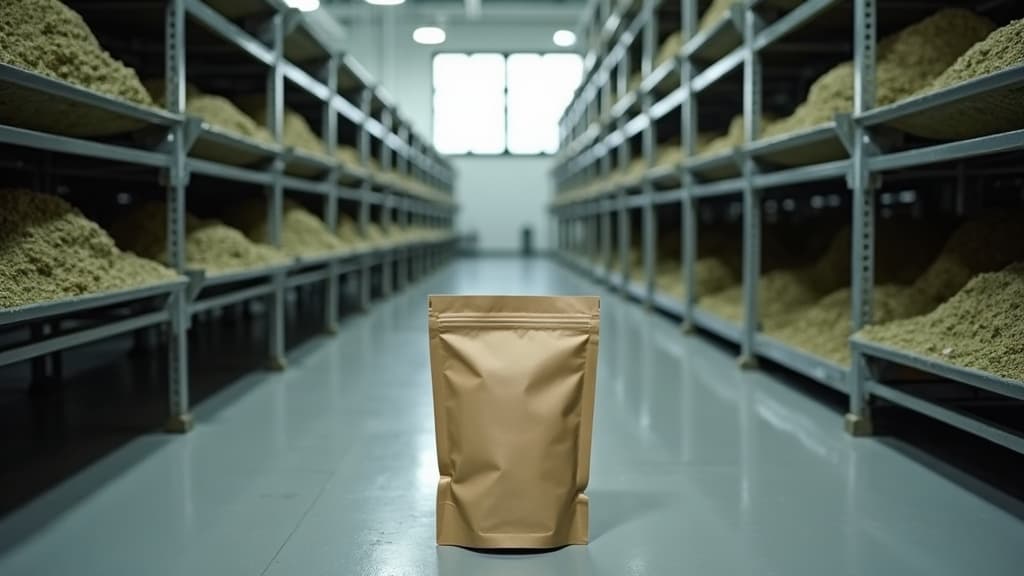
Walk into ten kratom retailers and you will see the same mistake nine times: a shelf stocked by price, not by format. Rows of cheap raw powder next to a single dusty extract bottle nobody can explain, and not an isolate in sight. The operators who actually make margin treat format as a strategy, not an afterthought — because each format buys a different shelf, a different customer, and a different markup.
Here is the operator-level breakdown of the three categories, what they cost you wholesale, how they move at retail, and where each one belongs in a lineup.
Raw powder: the volume floor, not the profit center
Raw material — bulk powder, crushed leaf, whole leaf — is the lowest-margin, highest-volume category in the business. It is the format every new buyer starts with because the per-kilo price looks irresistible, and it is the format that teaches every new buyer that per-kilo price is a trap.
Raw powder is a commodity. Your customer can price-shop it across fifty websites in an afternoon, which means your margin is capped by the cheapest operator willing to lose money for market share. The alkaloid content is whatever the leaf delivered — typically a Mitragynine fraction in the low single digits by dry weight — and you cannot standardize it after the fact without moving into extract territory.
Where raw powder earns its place: as a traffic driver and a basket builder. It is what brings the price-sensitive regular through the door. Stock it, price it honestly, and accept that its job is volume and loyalty — not the margin that keeps your lights on.
Standardized extract: where the margin actually lives
A standardized extract is alkaloid-enriched material with a guaranteed potency profile — the producer concentrates the active alkaloids and tests to a target percentage so every lot performs to spec. This is the difference that matters: raw powder is whatever the leaf gave you; an extract is a number you can put on a label and defend with a COA.
That standardization is what unlocks pricing power. You are no longer selling a commodity by the kilo — you are selling a known, repeatable specification, and a known specification commands a markup a bag of generic leaf never will. Extracts are where most healthy kratom retail margin actually lives.
Two things to verify before you stock one:
- The potency target is stated and tested per lot. "Enhanced" or "premium" with no number is marketing, not a specification. Demand the target Mitragynine percentage and a current Certificate of Analysis from a named, ISO/IEC 17025 accredited lab that confirms the lot hit it.
- The carrier and process are disclosed. How the alkaloids were concentrated affects consistency, appearance, and your cost basis. A producer who manufactures extract in-house will answer plainly; a broker will get vague.
Extract is the format that rewards a retailer who can explain the difference between a number and a vibe. If your floor staff can articulate why a standardized extract costs more than the bag next to it, you have a margin engine.
Isolate: the specialist tier, the compliance frontier
An isolate is purified single-alkaloid material — Mitragynine at 99%-plus purity. It is the highest-value, lowest-volume, and highest-scrutiny category in the lineup, and it is not a format you stock casually. (Concentrated 7-Hydroxymitragynine isolate is a separate regulatory question entirely, and one Elixir Keys does not supply — see below.)
Two realities define the isolate tier:
- Purity is a documentation game. At 99%-plus you are buying an analytical claim, and the claim is only as good as the COA behind it. The document must name the accredited lab, the batch lot, and the assay method. An isolate without rigorous third-party testing is not a premium product — it is a liability with a high price tag.
- The regulatory picture is sharpest here. Concentrated 7-Hydroxymitragynine is now the subject of federal scheduling action — as of mid-2026 the DEA has moved to place enriched 7-OH above a low threshold into Schedule I — which is precisely why Elixir Keys supplies Mitragynine isolate and does not deal in 7-OH isolate. Even for the formats we do carry, isolate belongs only in a lineup run by an operator who tracks state-by-state status and ships accordingly — legal where permitted, with compliance squarely the buyer's responsibility.
Where isolate earns its place: as the specialist anchor for a sophisticated, compliance-aware customer base, and as the raw input for formulators building finished goods to a precise spec. It is not a starter format. It is the tier you graduate into once your documentation discipline and your jurisdictional awareness are already tight.
Mapping format to price point
Stack the three formats and the retail logic falls out cleanly:
- Raw powder — entry price point, commodity margin, high volume. Job: foot traffic and loyalty.
- Standardized extract — mid-to-premium price point, real margin, steady volume. Job: profit center.
- Isolate — top price point, highest margin per unit, lowest volume, highest compliance load. Job: specialist anchor and formulator input.
A lineup that is all raw powder is a race to the bottom. A lineup that is all isolate is a compliance exposure with no foot traffic. The retailers who win run all three deliberately — powder to bring them in, extract to make the money, isolate to anchor the top and serve the buyer who knows exactly what they want.
The shortlist, one sentence each
Before you decide which formats belong on your shelf:
- Is this raw powder priced as a traffic driver, or am I fooling myself that it is a profit center?
- Does every extract I stock carry a stated potency target and a per-lot COA from a named accredited lab?
- Is the extract processed in-house by my supplier, or sourced from a partner whose diligence I cannot see?
- For any isolate, does the COA name the lab, the lot, and the assay method — and do I have a state-by-state shipping policy to match?
- Does my lineup cover all three jobs — traffic, margin, and anchor — or am I leaning on one format to do all three?
Get those five right and your shelf stops being a pile of inventory priced by the kilo and starts being a lineup that does a job.
If you are building or rebalancing a wholesale lineup across all three formats and want a supplier who can quote each one with the documentation to back it, request a wholesale quote and we will come back inside 24 hours.